
There are two ways to analyze any market: by its 'Fundamental' attributes or by its 'Technical' charts.
With the advent of personal computing and the internet, TA has become the dominant methodology for predicting stock, bond, commodity, and currency market cycles worldwide. It's used by ALL major investment banks and international trading desks as the underlying basis for trillions of dollars in daily transactions. TA is visual, relying on Supply & Demand charts — because those charts also track the most important and most elusive driver of future price trends: Market Psychology.
Until 2006 (when HousingAlerts first became publicly available), the data and tools to implement TA for local real estate markets simply did not exist. Before that, investors had to rely on old, inaccurate Fundamental Analysis (FA) because there was no alternative.
There are hundreds of FA factors that may (or may not) affect prices in any market at any time — Population, Mortgage Rate, Unemployment, Income, and less traditional ones like Climate, Vacancy, Building Permits, even gasoline prices. Historically many were thought to drive prices, but:
- Population isn't a good predictor: for the two decades before 2010, Texas had some of the largest population gains yet relatively dismal appreciation.
- Mortgage Rates were once considered the primary driver — a theory shattered when rates fell to historic lows simultaneously with the last crash.
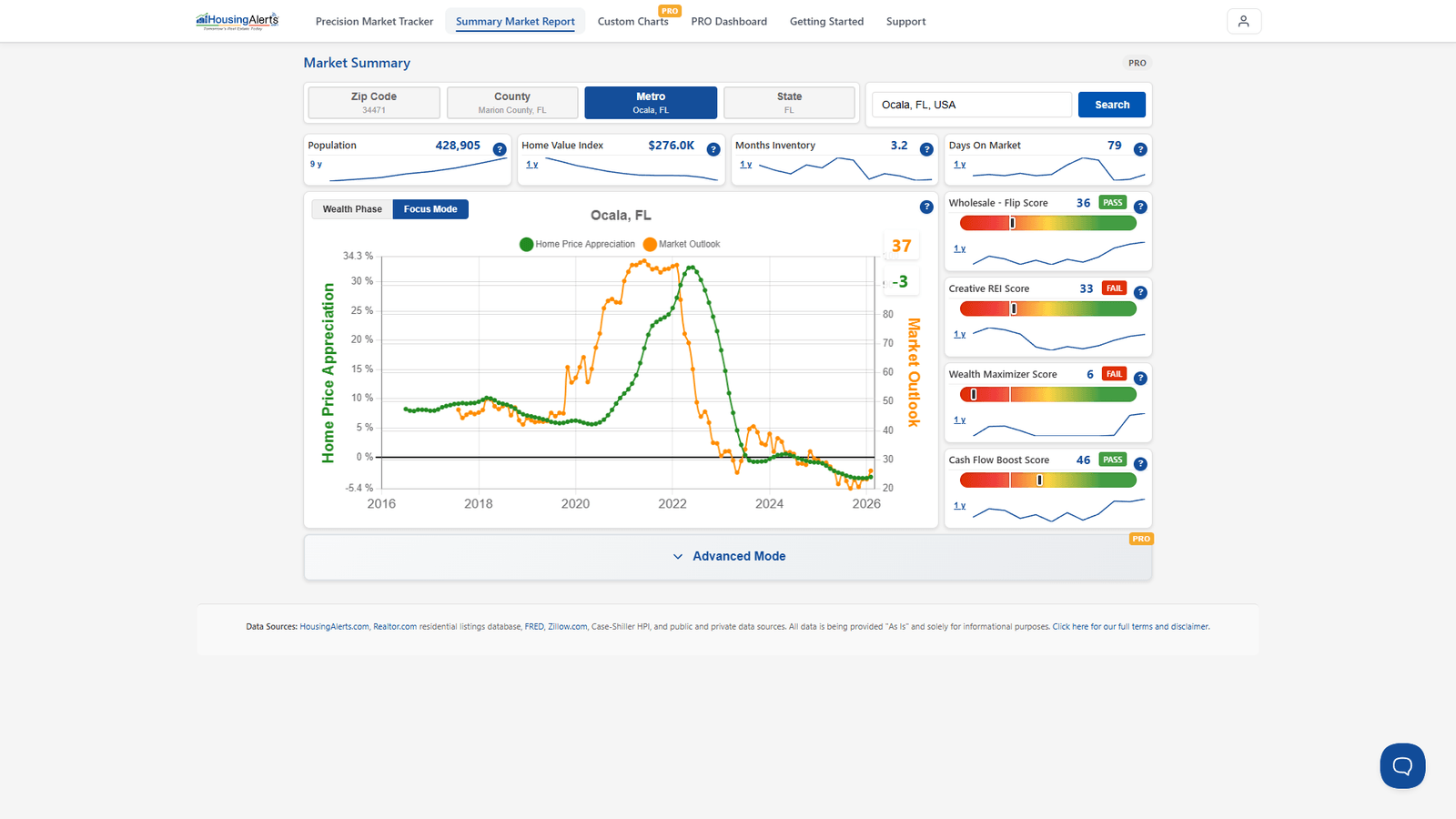
That's the problem with FA. TA, by contrast, already incorporates everything that actually moved prices — because it reads the price action itself. On the new platform, that TA read surfaces as the Market Outlook Score and the S.T.A.R. / T.A.P.S. / Wealth Phase studies in the Market Summary Report.