
Question:
We are a smaller/mid-sized lender and we are trying to determine areas of potential loan risk given where we believe we are in the housing cycle. What reports might be most relevant? I also suspect that the answer might be different depending on the loan product, as we do both a shorter-term loan as well as provide longer-term 30-year loans.
Answer:
One of the smarter ways to use these tools is computing the risk-adjusted return (or risk) for different markets. An identical property in a Hot vs. Crashing market should carry very different CAP rates given the different risks. Markets with a low probability of appreciation sell at higher CAP rates because they're riskier; long-term flat/declining markets cash-flow higher but carry greater risk of principal/equity loss. The same logic applies to lenders: flat and declining markets should command higher interest rates because they're higher-risk loans.
We analyze a market on two independent variables: 1) Technical Score (T.A.P.S. sliders) and 2) Momentum (S.T.A.R. circles). They don't always agree.
On the new platform, the easiest way to begin assessing that risk is The Table: rank every market by the Market Outlook Score (or a strategy score) to see, in one view, the strong markets (green) and the ones set to decline (red). When entering a market or pricing a new loan, you want BOTH strong S.T.A.R. momentum (green, especially Intermediate/Long Term) and strong T.A.P.S. scores; first confirm the market is even in a Wealth Phase.
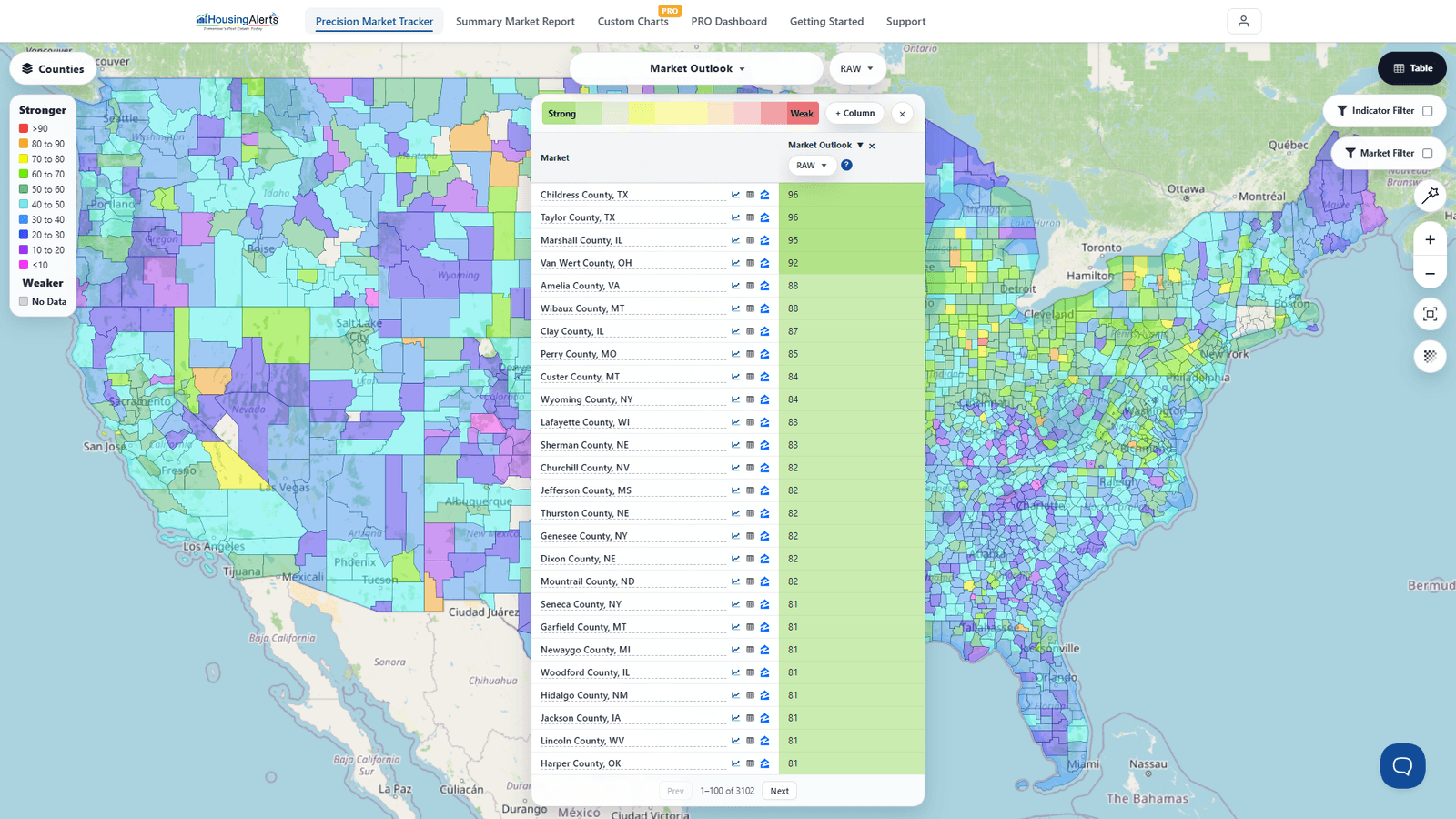
Rough importance when ENTERING / pricing a loan: 1) Wealth Phase, 2) Market Outlook Score, 3) S.T.A.R. Momentum, 4) T.A.P.S. Combined, 5) T.A.P.S. Local, 6) 1-Yr THAR, 7) 4-Yr THAR. When EXITING / assessing an existing book: 1) Wealth Phase, 2) T.A.P.S. Local, 3) 1-Yr THAR, 4) Market Outlook Score, 5) T.A.P.S. Combined, 6) S.T.A.R. Momentum, 7) 4-Yr THAR.
Since S.T.A.R. can give a year or more of advance warning of a reversal, it's valuable as an early-warning indicator even for loans you can't easily exit. For a true 30-year loan with no early payoff: (1) favor the hottest markets, so an early equity cushion from fast appreciation lowers your LTV; and (2) if you have no participation in the upside, consider avoiding highly cyclical markets (many Texas markets historically neither gained nor lost much) so your collateral doesn't evaporate in a downturn. To find flat/stable markets, review a state's long-term chart, or use Custom Charts PRO over a custom period (e.g. 2008–2012) to see which markets declined the least — then confirm their long-term stability.